
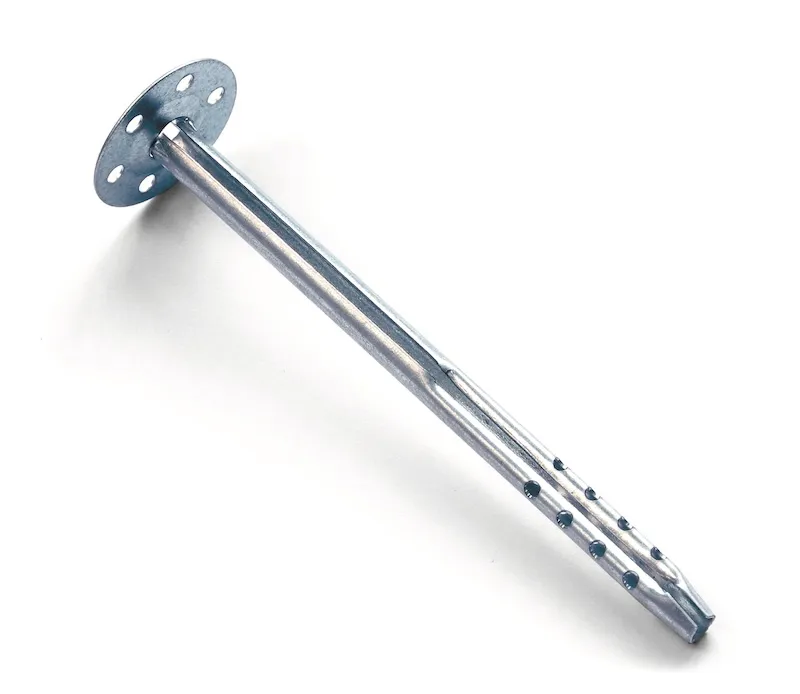
ID metal insulation board anchor for insulation & fire protection
- ✓ Fire protection up to F120
- ✓ Universal usability
- ✓ No buckling
At SMK Meister, we offer you a professional solution for the secure and durable attachment of insulation materials with the ID insulation board anchor. Our insulation board anchor is ideal for mounting self-supporting insulation boards on a wide variety of surfaces and impresses with its easy handling and reliable anchoring.
Facts about insulation board anchors
Metallic insulation board anchor with expansion mechanism
Lengths from 90 mm to 300 mm for insulation thicknesses 0-250 mm
steel, galvanized or stainless steel (VA)
≥B15 concrete, solid brick, sand-lime brick, porous concrete without pre-drilling
0.1 kN design resistance in cracked and uncracked concrete
Fire resistance class up to F120 according to DIBT test report
Benefits of the insulation board anchor at SMK Meister
One-piece fastener
Our insulation board anchor consists of a continuous metal part without loose components. This guarantees reliable assembly without risk of loss of small parts and consistently high mounting quality.
Clamping sleeve principle for secure anchoring
The insulation board anchor works according to the proven clamping sleeve principle. When driven in, the anchor tightens in the borehole and forms a force-locking connection with the substrate. This technology ensures maximum holding forces.
No buckling during installation
Thanks to the sturdy metal construction, our insulation board anchor does not buckle even when drilling deep holes. You can easily insert the anchor without it bending or changing its position.
Minimal drilling effort
With a borehole diameter of just 8 mm, the insulating plate plug is extremely gentle on the material. The slight interference with the subsoil significantly reduces dust, effort and potential damage to the building structure.
Wide range of lengths
SMK Meister offers the insulation board anchor in eight different lengths from 90 mm to 300 mm. This allows you to find the right solution for any insulation thickness from a few centimetres up to 250 mm.
Important information about insulation board anchors
What is an insulation board anchor and what is it used for?
An insulation board anchor is a special fastener for installing insulation materials on building facades and interior walls. At SMK Meister, we produce these ISO plugs from high-quality metal. They are used wherever self-supporting, pressure-resistant insulation materials must be securely anchored to the ground. Typical applications include facade insulation, composite thermal insulation systems and the internal insulation of buildings. The insulation board anchor penetrates the insulation board and anchors itself in the supporting surface.
What is the role of the dowel in fire protection of facades (F120)?
In demanding fire protection projects, the fire resistance of all components plays a decisive role. Our insulation board anchor is approved for fire resistance class F120. This means that in the event of a fire, the attachment performs its function for at least 120 minutes and keeps the insulation board secure. This property is particularly important for multi-storey buildings, public institutions and wherever there are increased fire safety requirements. The corresponding test reports document the suitability for these safety-critical applications.
Can the plug for insulation boards create a thermal bridge?
As a continuous metal element, an insulation board anchor can theoretically represent a minimal thermal bridge. However, this effect is very limited with our product due to the small cross section of only 8 mm. For the highest energy requirements, we also offer thermal protection caps. These caps cover the anchor and completely break the thermal bridge. With this combination, you can achieve optimal insulation values without sacrificing mounting security.
.webp)
Installing the insulation board anchor
Preparation/tool requirements
To properly install the insulation board anchor, all you need is a hammer drill with an 8 mm masonry drill, a hammer (approx. 500 g) and a vacuum cleaner to clean the borehole. Before you start, check whether the selected board anchor matches the insulation thickness. For soft insulation materials, our experts recommend the additional use of the T80 plate.
Carrying out the assembly
First, drill through the insulation board that has already been installed into the ground. The required drilling depth is shown in the table. Clean the borehole thoroughly from drilling dust. Then pass the insulation board anchor through the insulation board and hit it flush with the hammer until the anchor is firmly in the ground. As a result of the clamping sleeve effect, the board anchor firmly anchors itself.
Follow-up/testing
After hammering in, the anchor head should be flush with the insulation board surface. Check the firm anchoring by pulling gently. If necessary, you can now put on the optional thermal protection caps. The insulation board anchor can be loaded immediately.
What sets us apart
ISO certification
For us, quality is not a promise, but a proven standard. Our ISO certification proves that we consistently comply with the highest quality requirements in all areas of production — from sheet metal processing to fastening technology.
Reliability and punctuality
You can rely on us — not only when it comes to quality, but also when it comes to appointments. For over 50 years, our customers have known that we keep our promises. Timely delivery is not a bonus for us, but a natural part of our service.
Highly flexible corporate structure
As a family-run company, we respond quickly and unbureaucratically to your requirements. Short decision-making processes and an experienced team enable us to reliably implement even short-term orders, special solutions and changing requirements.
Innovations in fastening technology
Our product portfolio in fastening technology is constantly growing — driven by real practical requirements. Whether tilting bolts, heavy-duty folding plugs Big M or Balkonfix: Many of our products were developed in close cooperation with customers and are the result of decades of development work.
Approved and tested products
Our mounting solutions are not only tried and tested, but are also officially approved and tested. This gives you products that you can blindly rely on in safety-relevant applications, such as in construction and façade technology.
Open for individual customer projects
Standard solutions are a good start — but not always the best answer. We take the time to understand your specific requirements and work with you to develop tailor-made solutions in sheet metal and fastening technology.
FAQ - Frequently Asked Questions about insulation board anchors
Does the metal dowel also hold in porous concrete (aerated concrete)?
Yes, our insulation plate plug is specifically suitable for aerated concrete of strength class G2 without pre-drilling. Here too, the recommended load is 0.1 kN. The clamping sleeve principle of the plate plug also works reliably in this lighter building material.
What are the optional thermal protection caps for?
The thermal protection caps with diameters of 54 mm and 38 mm completely cover the metallic insulation board anchor. As a result, any potential thermal bridge is eliminated. We offer the caps in white, beige and grey so that you can visually match them to your facade. Pre-assembly is available on request.
What is the minimum and maximum insulation thickness?
With our range, we cover insulation thicknesses from a few millimeters to 250 mm. The shortest plate plug ID 30 is suitable for insulation boards of 0-40 mm, the longest ID 250 for thicknesses of 200-250 mm. Six other variants are available for intermediate sizes.
How many dowels are needed per square meter of facade?
The required number of insulation plate plugs per square meter depends on the type of insulation material, wind load and building authority requirements.
Are there different plate sizes and what are they for?
Yes, at SMK Meister, we offer the T80 plate with an outer diameter of 85 mm. This is used for soft insulation materials and prevents the insulation plate plug from sinking into the material. With self-supporting, pressure-resistant insulation boards, the plate can be omitted.
Can the plug be plastered?
Yes, the insulation board anchor can easily be plastered over. However, we recommend using our thermal protection caps for facade systems. These create a flat surface and optimize the insulation effect. The anchor thus disappears completely under plaster or topcoat.