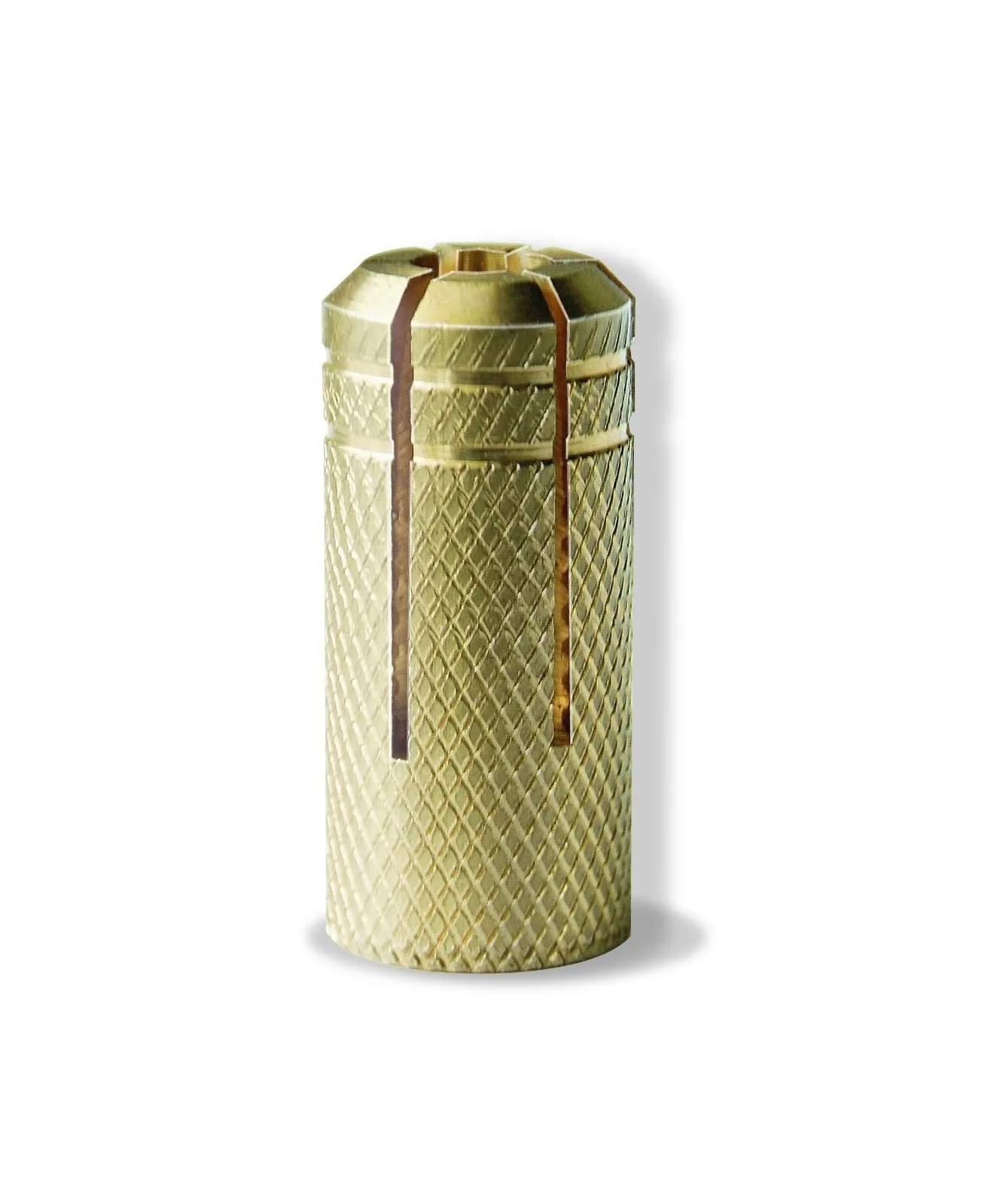
Brass anchor with metric internal thread - from M4 to M16
- ✓ Metric internal thread M4 to M16
- ✓ Knurled outer surface
- ✓ Corrosion resistant
At SMK Meister, we offer you high-quality brass anchors for professional fastening solutions in a wide variety of building materials. With over 50 years of industry experience as a fastening specialist, we know exactly what matters when it comes to reliable fastening elements. Our brass anchors with metric internal thread combine all the advantages you need for secure and durable fastening: the highest dimensional accuracy, excellent material quality and well-thought-out design.
The brass anchor is designed as an expansion anchor and is ideal for efficient push-through assembly in combination with all metric screws from M4 to M16. Thanks to its gradual cone and knurled outer surface, this anchor ensures high holding forces and is absolutely rotation-proof. Whether in professional trades, industry or demanding DIY projects — our brass anchors convince through reliability and easy handling.
Facts about brass anchors
Spreader plug with metric internal thread
Outer diameter 5.0 mm to 20.0 mm | Length 10 mm to 44 mm
brass
concrete, solid bricks, natural stones, clinker bricks, sand-lime bricks, solid wood, laminated timber
Depending on size and surface, 200 N to 3300 N
Certified quality standards in accordance with DIN ISO 9001
Benefits of the brass plug at SMK Meister
Optimal force transmission through expansion mechanism
The gentle cone in the brass anchor ensures even distribution of the expansion effect in the borehole when the screw is tightened. This results in optimal force transmission to the substrate, leading to the highest load capacity.
Wide size selection
With our state-of-the-art machinery, we manufacture brass anchors in all standard thread sizes from M4 to M16. So you will find the right size for every application.
Corrosion resistance for long service life
Brass is naturally corrosion-resistant and is therefore ideal for use in moist environments or outdoor areas. Our brass anchors retain their functionality for years to come.
Versatile applications
The brass anchor is suitable for a wide range of building materials — from concrete through various types of stone to solid wood and laminated timber. This versatility makes it the ideal fastening element for a wide variety of projects.
Efficient push-through assembly
At SMK Meister, we focus on simple and time-saving assembly solutions. The brass anchor enables push-through assembly — simply push through, insert and tighten.
Important information about brass anchors
How does knurling prevent rotation in the borehole?
The knurled outer surface of the brass anchor is one of its most important design features. The knurling consists of fine, circumferential grooves that work into the borehole wall when screwed in. This effect is created by the cone of the anchor, which presses outwards when the screw is tightened and presses the knurled surfaces firmly against the borehole. This creates a form-fitting connection that prevents rotation even at high torques. Our expert team particularly recommends the brass anchor when you need absolutely rotation-proof connections.
Is the anchor suitable for metric screws and threaded rods?
Yes, the brass anchor has a precisely manufactured metric internal thread and is therefore perfect for all standard metric screws. You can use both machine threaded screws and threaded rods. The available sizes range from M4, M5, M6 and M8 to M10, M12, M14 and M16. With over 50 years of experience in fastening technology, we know how important precise fit is — our ultra-modern production guarantees this for every single brass anchor.
Can I use the brass anchor in wood or laminated timber?
Absolutely! The brass anchor is not only suitable for mineral building materials such as concrete or masonry, but also for solid wood and laminated timber. The advantages of the brass anchor are particularly appreciated in timber construction: it is corrosion-resistant, works securely into the material and offers reliable holding forces. At SMK Meister, we particularly recommend brass anchors M6 and M8 for wood applications, as they are optimally tailored to the properties of timber materials. The knurled surface ensures perfect grip even in softer materials.
.webp)
Installing the brass anchor
Preparation/tool requirements
For proper installation of the brass anchor, you only need basic equipment: a hammer drill or percussion drill with appropriate masonry drill (diameter see table), a vacuum or blow gun to clean the borehole, and a screwdriver or spanner to tighten the screw. At SMK Meister, we value ease of handling — specialist tools are not required. Make sure you use the correct drill diameter, as this is critical for load capacity. For a brass anchor M8, for example, you need an 11 mm drill; for a brass anchor M10, you need a 13 mm drill.
Carrying out the assembly
Assembly is carried out using the proven push-through method: First drill a hole in the substrate with the diameter and required depth specified in the table. Clean the borehole thoroughly from drilling dust. Now manually screw the threaded screw into the brass anchor so that about 2-3 threads still protrude from the anchor. Insert the pre-assembled unit through the prepared mounting hole of your component and fully insert the expansion anchor into the borehole. Now tighten the screw with a screwdriver or spanner — the cone expands and the knurling works into the borehole wall. The brass anchor is fully loadable immediately after installation.
Follow-up/testing
After tightening, you should briefly check that the brass anchor is flush with the surface and is firmly seated. A gentle pull on the component shows you whether the connection is stable. Thanks to the rotation-proof design with knurling and the corrosion-resistant brass material, no further aftertreatment is required. When installed correctly, our brass anchors guarantee years of reliability without maintenance.
What sets us apart
ISO certification
For us, quality is not a promise, but a proven standard. Our ISO certification proves that we consistently comply with the highest quality requirements in all areas of production — from sheet metal processing to fastening technology.
Reliability and punctuality
You can rely on us — not only when it comes to quality, but also when it comes to appointments. For over 50 years, our customers have known that we keep our promises. Timely delivery is not a bonus for us, but a natural part of our service.
Highly flexible corporate structure
As a family-run company, we respond quickly and unbureaucratically to your requirements. Short decision-making processes and an experienced team enable us to reliably implement even short-term orders, special solutions and changing requirements.
Innovations in fastening technology
Our product portfolio in fastening technology is constantly growing — driven by real practical requirements. Whether tilting bolts, heavy-duty folding plugs Big M or Balkonfix: Many of our products were developed in close cooperation with customers and are the result of decades of development work.
Approved and tested products
Our mounting solutions are not only tried and tested, but are also officially approved and tested. This gives you products that you can blindly rely on in safety-relevant applications, such as in construction and façade technology.
Open for individual customer projects
Standard solutions are a good start — but not always the best answer. We take the time to understand your specific requirements and work with you to develop tailor-made solutions in sheet metal and fastening technology.
FAQ - Frequently Asked Questions about brass anchors
Do I need to use special brass screws?
No, you don't need special brass screws. The brass anchor works with all standard metric screws of the appropriate thread size. You can use machine screws, hexagon head screws or threaded rods. It is only important that the thread of the screw matches the thread size of the anchor.
Can I remove the anchor again?
Yes, the brass anchor can be removed again if necessary. Simply unscrew the screw. The anchor itself can then be pulled out of the borehole using pliers or a suitable tool. Due to the knurling, it sits tight, but can still be released.
Can the anchor be loaded immediately after installation?
Yes, the brass anchor as an expansion anchor is fully loadable immediately after the screw is tightened. No curing time or setting phase is required. The mechanical expansion effect occurs immediately upon tightening and the connection is immediately stable.
What loads can an M8 brass anchor bear?
An M8 brass anchor can carry different loads depending on the substrate. In concrete with compressive strength ≥ 25 N/mm², the recommended working load is 1100 N. In solid bricks with ≥ 15 N/mm² compressive strength, it is 900 N.
Is the anchor corrosion-resistant for outdoor use?
Absolutely! Brass is a naturally corrosion-resistant material that is ideal for outdoor use. The brass anchor resists moisture and weather effects for many years.
What screw length do I need for proper expansion?
The screw length results from the thickness of your component plus the anchoring depth of the brass anchor. As a rule of thumb: screw length = component thickness + anchor length + approximately 5 mm reserve. For optimal expansion effect, the screw should pass through at least the entire anchor. Our expert team at SMK Meister will be happy to help you select the appropriate screw dimensions for your specific application.